NSSO Survey: Only 39.1% of all Households have Drinking Water Within Dwelling, 46.7% of Rural Households use Firewood for Cooking


 Published on May 2, 2023
Modified on May 4, 2023
Published on May 2, 2023
Modified on May 4, 2023
|
The National Sample Survey Organization's Multiple Indicator Survey – part of the 78th round – has revealed that only 39.1 percent of all Indian households have access to drinking water within the dwelling. When it come to cooking, 46.7% of rural households use firewood. These are some of the findings of the survey whose purpose was to collect data about the indicators of Sustainable Development Goals. Data was collected for households and population; drinking water and sanitation; household energy use; education and ICT skills; mobile/broadband and mass media; financial inclusion and indebtedness; birth registration; purchase/construction of new house; migration. The key findings are:
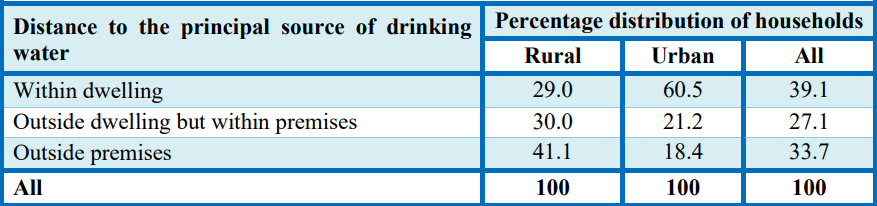
Table 1: Percentage distribution of households by distance to the principal source of drinking water
Source: NSS Report No. 589: Multiple Indicator Survey in India, Ministry of Statistics and Programme Implementation
The table above reveals that 60.5 percent of urban houselholds and 29 percent of rural households have access to drinking water within the dwelling. The all-India average works out to 39.1 percent. 21.2 percent of urban and 30 percent of rural households' primary source of drinking water is outside the dwelling, but within the premesis of residence, whereas 18.4 percent of urban and 41.1 percent of rural households have to step outside the premesis to get their water.
Donut Chart
A household was considered to have access to a latrine if majority of the household members had the facility of using latrine irrespective of whether it was used by them or not. Information on access to latrine was collected in terms of six categories: (i) exclusive use of household, (ii) common use of households in the building, (iii) public/community use without payment, (iv) public/community use with payment, (v) others and (vi) no latrine. The chart above gives the average of urban and rural households. Breaking it down into the two categories, 80.8 percent of urban households had exclusive use of a latrine, while among rural households that number was just 68.8 percent. Significantly, 21.3 percent of rural households had no access to a latrine.
Chart 1: Percentage distribution of households by primary source of energy used for cooking
Chart 2: Persons aged 18 and above who have an active mobile and SIM card in the three months prior to survey
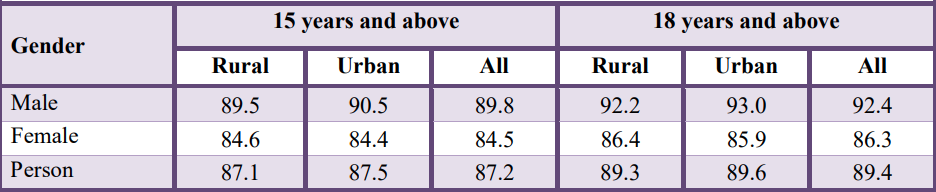
Table 2: Percentage of persons who have an account individually or jointly in any bank/ other financial institution/mobile money service provider
The survey was initially planned for January-December, 2020, but due to Covid 19 pandemic, but the the data collection was extended to August 2021. For the central sample, the survey was spread over 14,266 first stage units (8,469 in rural areas and 5,797 in urban areas) covering 2,76,409 sample households (1,64,529 in rural areas and 1,11,880 in urban areas). Please click here to access the NSSO Report References |
National Sample Survey Organization, https://www.mospi.gov.in/sites/default/files/publication_reports/MultipleIndicatorSurveyinIndiaf_0.pdf
Tagged with: 78th Round Drinking Water Education Financial Inclusion Household Energy Use Mass Media Migration Mobile Broadband Multiple Indicator Survey National Sample Survey NSSO Sanitation




Write Comments