
Right to Information


What’s Inside
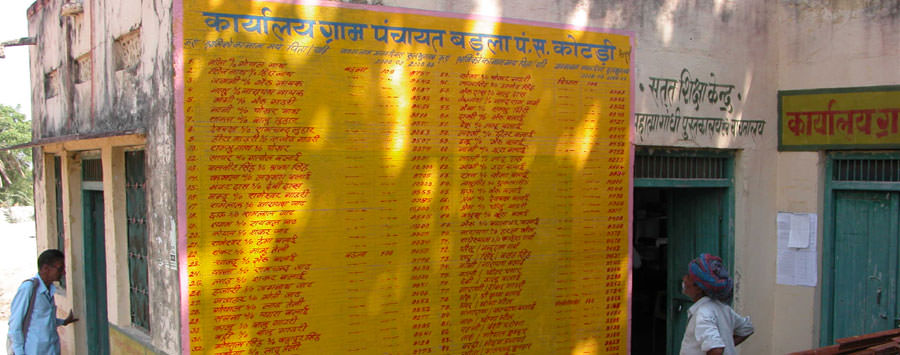
According to the Final Report of the Vision Foundation (2005), http://planningcommission.gov.in/reports/sereport/ser/stdy * Freedom of expression is protected in Article 19 of the Constitution of India: All citizens shall have the right to freedom of speech and expression * In 1982, the Supreme Court of India ruled that access to government information was an essential part of the fundamental right to freedom of speech and expression. The Court stated, “ The concept of an open Government is the direct emanation from the right to know which seems implicit in the right of free speech and expression guaranteed under Article 19(1)(a). Therefore, disclosures of information in regard to the functioning of Government must be the rule, and secrecy an exception justified only where the strictest requirement of public interest so demands. The approach of the Court must be to attenuate the area of secrecy as much as possible consistently with the requirement of public interest, bearing in mind all the time that disclosure also serves an important aspect of public interest”. * Section 76 of the Indian Evidence Act, 1872, contains what has been termed a ‘Freedom of Information Act in embryonic form’. This provision requires public officials to provide copies of public documents to anyone who has a right to inspect them. * The system of governance in India has traditionally been opaque, with the State retaining the colonial Official Secrets Act (OSA) and continuing to operate in secrecy at the administrative level. The OSA enacted in 1923 was functional in its original form, apart from some minor amendments in 1967. These provisions had been roundly criticised. The Central Civil Service Conduct Rules, 1964 bolstered the provisions of the OSA by prohibiting government servants from communicating any official document to anyone without authorisation. * Section 123 of the Indian Evidence Act, 1872 prohibited the giving of evidence from unpublished official records without the permission of the head of the relevant department, who is free to grant or to withhold such permission as he or she sees fit. * The poor flow of information is compounded by two factors — low levels of literacy and the absence of effective communication tools and processes. In many regions, the standard of record keeping is extremely poor. Most government offices have stacks of dusty files everywhere, providing an easy excuse for refusing access to records on the specious excuse that they have been ‘misplaced’. * In the early-1990s, in the course of the struggle of the rural poor in Rajasthan, the Mazdoor Kisaan Shakti Sangathan (MKSS) hit upon a novel way to demonstrate the importance of information in an individual’s life — through public hearings or Jan Sunwais. The MKSS’s campaign demanded transparency of official records, a social audit of government spending and a redressal machinery for people who had not been given their due. The campaign caught the imagination of a large cross-section of people, including activists, civil servants and lawyers. * The Press Council of India drew up the first major draft legislation on the right to information in 1996. The draft affirmed the right of every citizen to information from any public body. Significantly, the term ‘public body’ included not only the State, but also all privately-owned undertakings, non-statutory authorities, companies and other bodies. * Next came the Consumer Education Research Council (CERC) draft, by far the most detailed proposed freedom of information legislation in India. In line with international standards, it gave the right to information to anyone, except "alien enemies" * Finally in 1997, a conference of Chief Ministers resolved that the central and state governments would work together on transparency and the right to information. Following this, the Centre agreed to take immediate steps, in consultation with the states, to introduce freedom of information legislation, along with amendments to the Official Secrets Act and the Indian Evidence Act, before the end of 1997. * Even before the Central FOI (Freedom of Information) Act was passed some of the States introduced their own right to information legislation. The first amongst these was Tamil Nadu (1997), which was followed by Goa (1997), Rajasthan (2000), Karnataka (2000), Delhi (2001), Maharashtra (2002), Assam (2002), Madhya Pradesh (2003) and Jammu & Kashmir (2004). * The Freedom of Information Act 2002 (FOIA) was passed in December 2002 by the Government of India and received the Presidential assent in January 2003. This legislation was to be uniformly applicable all over the country. But, the provisions of the Act was criticised by the Civil Society, calling it ineffective. According to Safeguarding the Right to Information-Interim Findings of the People’s RTI Assessment 2008, October 2008, conducted by RTI Assessment & Analysis Group (RaaG) and National Campaign for People’s Right to Information (NCPRI) (in collaboration with other institutes/ organizations), http://rti-assessment.org/interim_report.pdf • The Right to Information Act suffers from the problems of a weak infrastructure and public information officers (PIOs) who are unaware of their exact role. Almost half the PIOs interviewed in rural India said they were not aware that they were PIOs • An overwhelming number of PIOs—nodal officers who receive and dispense with RTI applications — cite lack of training and unfamiliarity with the law as key hurdles in their ability to effectively service RTI requests • The RTI Act has made a positive impact on the lives of people like no other Act has done before. More and more people are filing RTI queries to procure information, which was earlier denied by government officials. • The government responds, though sometimes slowly. Of the total RTI applications filed, nearly two-thirds got a response from the public authorities. However, only a third of these applications were responded to within the stipulated 30 days. • Meghalaya was “the worst performer” with no PIOs found at the village level, while Rajasthan was “the best performer” with nearly all PIOs available and interviewed. The other major finding of the study was that more men than women were using RTI across the country. Rural applicants were overwhelmingly male. And the same goes for Delhi, where over three-fourths of 162 randomly selected applicants surveyed were male • In Maharashtra, the Act has been a success with around 3.7 lakh citizens filing RTI queries in the last three years. RTI activists and citizens, however, say the growing pendency of second appeals is cause for concern. International best practices on RTI
|
Rural Expert



Write Comments